
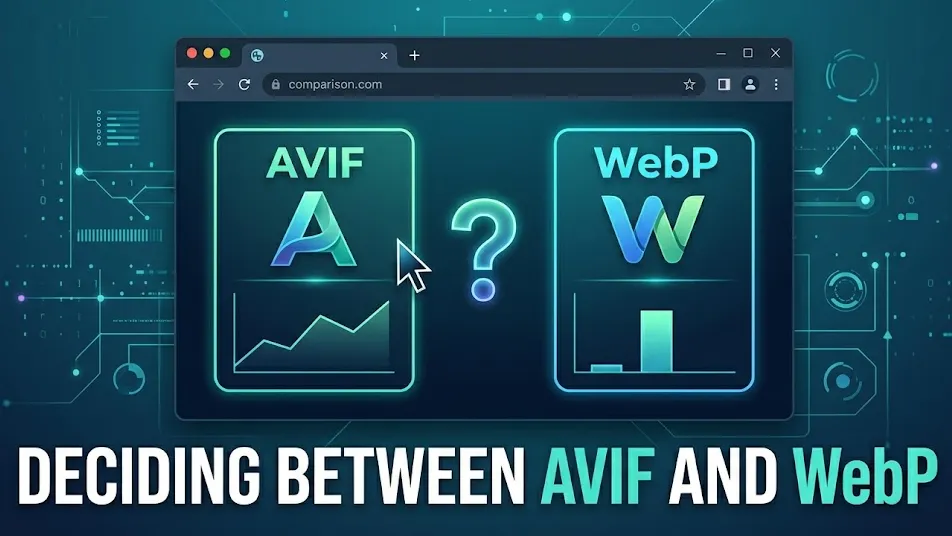
WebP vs. AVIF: Performance, Quality & Compression in 2026
The best image format is rarely the most hyped one. WebP and AVIF are both designed for performance, but the right choice depends on compatibility, file size, and whether the image needs crisp edges, transparency, or the most efficient delivery path.
By Cloudy Convert
Practical guides from the Cloudy Convert team on files, formats, privacy, and digital workflows.
The Evolution of Modern Image Formats
For decades, JPEG and PNG dominated web images. JPEG handled photographs while PNG supported transparency. As websites grew heavier and mobile traffic increased, compression efficiency became critical for performance.
New formats such as WebP and AVIF were developed to drastically reduce file size while preserving visual quality. Both formats support modern compression algorithms, transparency, and improved metadata handling.
Understanding the Two Formats
WebP: The Established Standard
Created by Google, WebP delivers strong compression and wide browser compatibility. It supports transparency, animation, and both lossy and lossless compression modes.
AVIF: Next-Generation Compression
AVIF is built on the AV1 video codec. It achieves extremely high compression efficiency and supports HDR, wide color ranges, and deeper bit depth than WebP.
Compression, Quality, and Performance
Understanding how WebP and AVIF differ in compression, image fidelity, and processing speed is crucial for selecting the best format for modern web projects. Proper format choice can reduce page weight, improve load times, and maintain high visual quality.
Maximum Compression
AVIF achieves superior compression, often producing files 20–40% smaller than WebP without noticeable quality loss. Reduced file sizes improve page speed and are ideal for media-rich websites.
High-Fidelity Visuals
AVIF supports 10–12-bit color depth and HDR, eliminating gradient banding and preserving subtle details. WebP is limited to 8-bit but still delivers solid quality for most web images.
Performance & Speed
WebP encodes and decodes faster, making it ideal for high-volume pipelines. AVIF reduces network transfer times with smaller files, boosting page load performance despite slightly longer encoding times.
Test the Choice on Your Own Images
Benchmarks are useful, but your subject, quality setting, and browser mix decide the practical winner. Compare an AVIF and WebP export side by side before adding either to production.
Compare AVIF and WebPTechnical Comparison
| Feature | AVIF | WebP |
|---|---|---|
| Compression Efficiency | Excellent | Very Good |
| File Size Reduction | Up to 50% smaller than JPEG | About 30% smaller than JPEG |
| Color Depth | Up to 12-bit HDR | 8-bit |
| Transparency | Supported | Supported |
| Encoding Speed | Slower | Faster |
| Browser Support | High and growing | Near universal |
How the Compression Technology Works
Both WebP and AVIF rely on modern predictive compression algorithms. Instead of storing every pixel individually, the encoder analyzes patterns, textures, and color blocks across the image. Redundant data is removed while maintaining visual accuracy.
AVIF inherits its compression engine from the AV1 video codec, which allows it to achieve extremely small file sizes. WebP uses a VP8-based compression model optimized for fast encoding and decoding.
Impact on Web Performance
Faster Page Loading
Smaller image files reduce network transfer time, improving Largest Contentful Paint and overall page responsiveness.
Lower Bandwidth Usage
Highly compressed images reduce server bandwidth and data consumption for users on mobile networks.
Recommended Strategy for Modern Websites
Use AVIF for hero images and large photography where compression efficiency has the greatest impact.
Use WebP as a fallback format to guarantee compatibility across older browsers and environments.
Deliver images through responsive HTML picture elements so browsers automatically select the best supported format.